South Africa’s homebuyers may have entered Q2 2026 with a heightened sense of caution in light of geopolitical tension, but the local housing market around them has continued to hold firm. This is reflected in ooba Home Loans’ Q2 ‘26 data, which shows positive growth in average purchase prices, approved bond sizes and bank lending appetite, despite a challenging economic backdrop.
WORDS & GRAPHS: SUPPLIED
The quarter coincided with a sharp rise in fuel prices, mounting inflationary pressure and the first interest rate increase in several years, after the South African Reserve Bank raised the prime lending rate by 25-basis points in May.
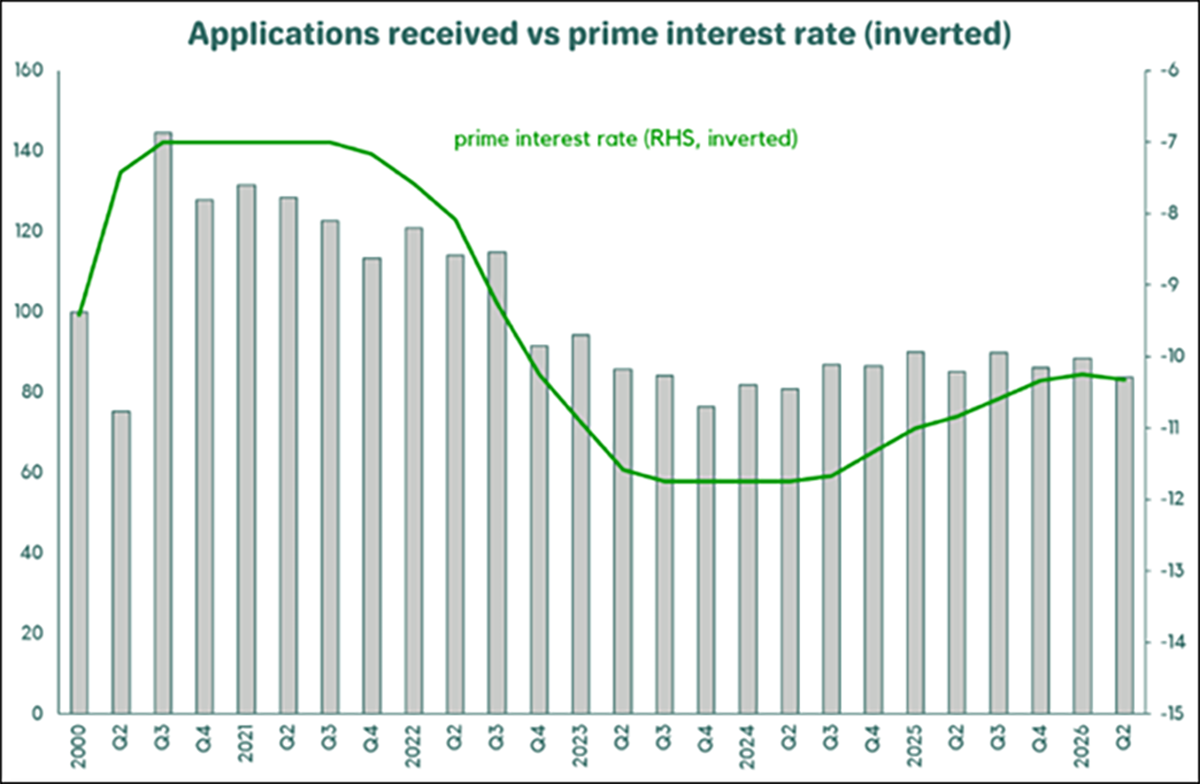
“Given the pressure on household budgets, some moderation in activity was to be expected,” says Rhys Dyer, CEO of the ooba Group. “However, the data points to a pause rather than a reversal. While the volume of applications over the period eased slightly by 1.5% compared to year-earlier levels, the total value of applications trended 4.7% higher over the same period,” he explains. “This suggests that although the demand may be slightly lower, the purchase prices of the properties bonded in this period remains intact.”
The longer-term trend reinforces the close relationship between borrowing costs and home loan activity, with application volumes typically softening as the prime lending rate rises and strengthening once rates stabilise and begin to ease. “Q2 ‘26’s moderation therefore reflects increased sensitivity to affordability rather than a loss of appetite for homeownership,” says Dyer. “Once inflationary pressures ease and the interest rate outlook becomes clearer, we expect homebuyer confidence and application activity to strengthen.”
SOURCE: ooba Home Loans and South African Reserve Bank.
Homebuyers Transact at Higher Values
Despite a moderation in home loan activity during the quarter, ooba Home Loans’ Q2 ‘26 data shows continued strength in property values. The average purchase price increased by 4.2% year-on-year and 1.6% quarter-on-quarter to R1,766,796, indicating that the prices being paid for properties continues to outpace consumer inflation. First-time homebuyers also paid more for property, with the average purchase price rising by 6.1% year-on-year and 3.9% quarter-on-quarter to R1,315,396.
Year-on-year growth in the average approved bond size followed a similar pattern, rising by 5% across all approved home loan applications in Q2’26, with approved first-time homebuyers applications recording an impressive 7.9% year-on-year average bond size growth. “Approved bond size growth is trending above property price growth, signalling that banks have continued to support qualifying buyers with more attractive lending terms as property values rise,” Dyer shares. “This is particularly encouraging for first-time homebuyers, who are purchasing more expensive homes and receiving larger loans despite being the segment most sensitive to higher borrowing costs.”
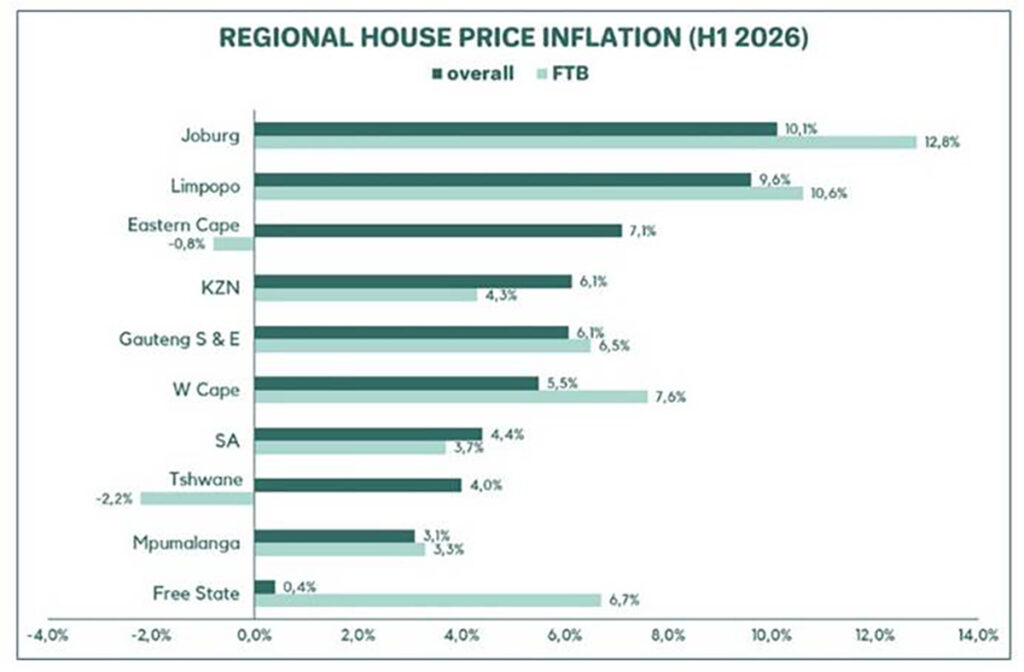
Focusing on regional purchase price trends, Johannesburg recorded the strongest overall house price growth at 10.1%, followed by Limpopo at 9.6% during the first half of the year.
As the two most affordable markets in the country, the Free State bucked the trend with first-time homebuyer prices increasing by 6.7% compared to overall growth of 0.4%, while Gauteng South & East recorded closely aligned growth across both the first-time homebuyer and overall categories.
SOURCE: ooba Home Loans.
Affordability Drives First-Time Buyer Activity – but Regional Outliers Remain
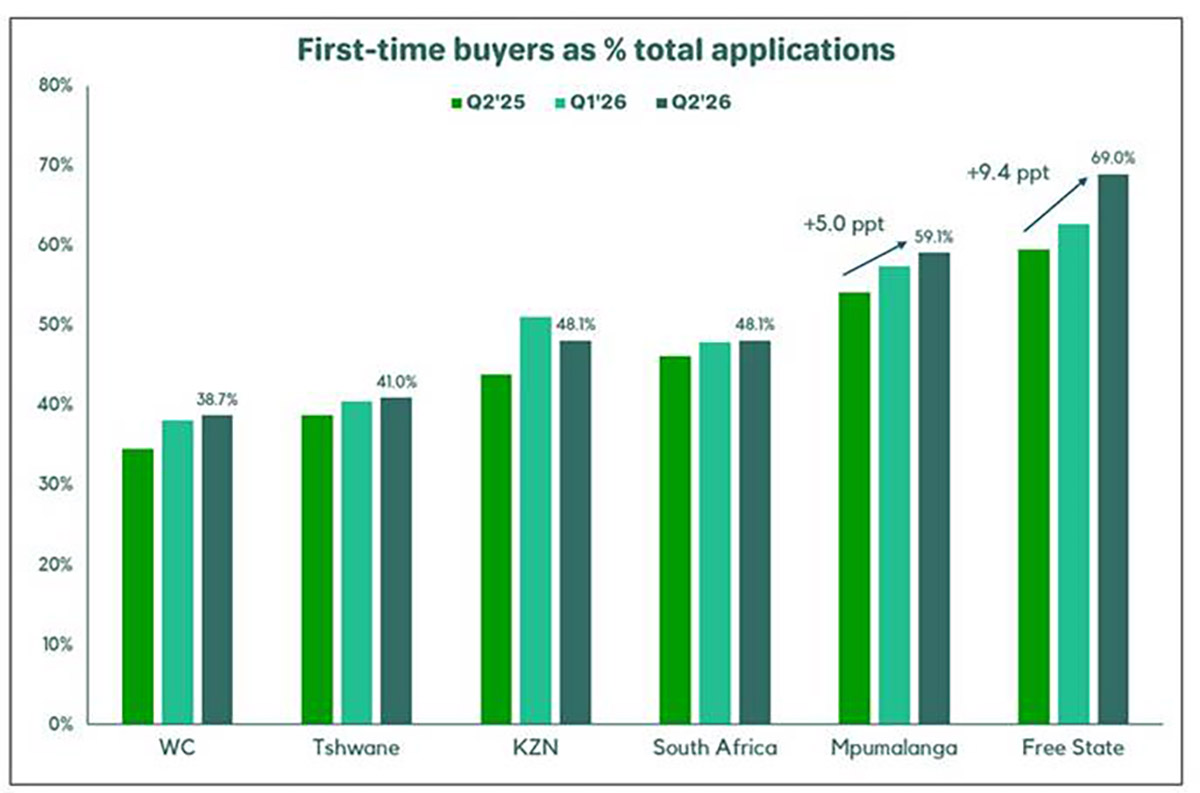
“Affordability strongly influenced where first-time homebuyer participation was highest in Q2 ‘26. This market segment accounted for 69% of all home loan applications in the Free State, up 9.4 percentage points year-on-year, followed by Mpumalanga at 59.1%, up five percentage points,” says Dyer.
Although first-time homebuyer demand weakened in four of the nine regions monitored by ooba Home Loans – Limpopo, the Eastern Cape, Gauteng South & East and Johannesburg – activity in the Western Cape held firm. First-time buyers accounted for almost 39% of the province’s home loan applications in Q2 ’26, despite the Western Cape having the country’s highest average first-time buyer purchase price.
Higher-LTV Loans Help Buyers Overcome Upfront Costs
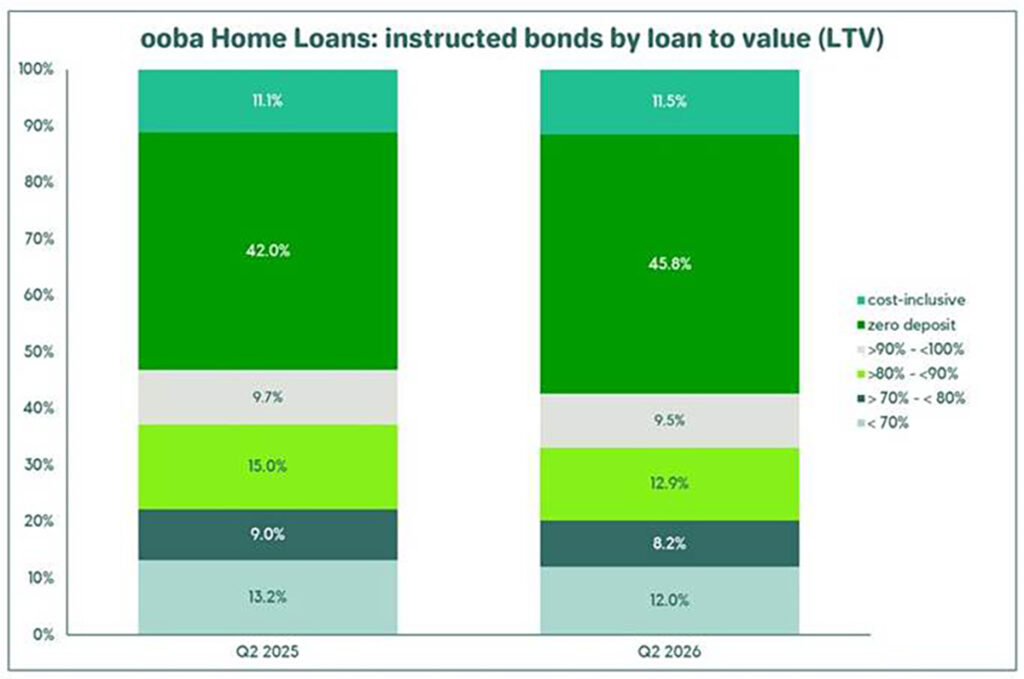
Although first-time homebuyers remain particularly exposed to interest rate and cost-of-living pressures, high loan-to-value (LTV) finance is helping keep the market accessible. “Their average deposit fell from 10.4% of the purchase price in Q2 ’25 to 8.9% in Q2 ’26, even as the average purchase price paid increased significantly during the same period,” Dyer explains.
SOURCE ooba Home Loans.
The shift is also evident across the broader market. “Year-on-year growth in the total value of instructed bonds was concentrated in loans covering 90% or more of the purchase price. Zero-deposit bonds led the way, with the total value rising by 14.3%, while the value of cost-inclusive bonds (>100%), which can also cover transfer duty and bond registration costs, grew by 7.9%.”
Zero-deposit home loans accounted for more than 56.9% of all applications received during the first half of 2026, with demand also rising for cost-inclusive home loans. “The continued availability of these products demonstrates that homebuyers with limited upfront capital may still have viable financing options, provided they meet the banks’ affordability and credit requirements,” adds Dyer.
Banks Back Buyers Despite Prevailing Conditions
Despite global uncertainty, one thing is clear: The banks are still willing to lend. “Our data underpins the prevailing trend that we continue to see despite the climate, the banks continue to support homebuyers and are hungry for home loan business,” says Dyer, highlighting ooba Home Loans’ trailing effective approval rate – up from 82.8% in Q2 ‘25 to 84.5% in Q2 ‘26.
At the same time, the proportion of applications declined by one lender, but approved by another increased from 46.9% to 48.4% – meaning that almost 50% of applicants rejected by one bank subsequently secured an approval elsewhere simply by shopping around.
“This is one of the clearest illustrations of why a single bank’s decision shouldn’t always be viewed as the ultimate determiner,” says Dyer. “Different banks assess applications differently, based on their own risk models and appetite at the time. Comparing offers can materially improve a homebuyer’s chances of home loan approval, and the terms they’re offered.”
Competition among lenders also continues to support attractive pricing. The average weighted concession secured for ooba Home Loans customers in Q2 ‘26 remained highly competitive at prime less 0.66%, broadly unchanged from the previous quarter and year.
“Banks remain focused on growing their share of the home loan market, and qualified buyers continue to benefit through strong approval rates, competitive interest rate discounts and reduced deposit requirements,” Dyer adds.
Stability Should Restore Momentum
Looking ahead, Dyer believes that the housing market’s performance in the second half of the year will depend largely on developments in the Middle East, particularly whether the Strait of Hormuz remains open, as this will influence fuel prices, inflation and interest rates. “If external pressures persist, higher living and borrowing costs may continue to influence buyer behaviour,” says Dyer.
Closer to home, improved logistics and recent sovereign ratings upgrades have helped support confidence, despite rising transport and municipal costs. “Banks remain competitive for quality borrowers, helping sustain demand for well-priced homes in established areas.”
Dyer also notes that household resilience may prove more important than interest rates alone. Homebuyers’ ability to manage ongoing cost pressures and maintain stable and growing incomes will ultimately determine market activity. While interest rates are expected to remain elevated for longer, further hikes are likely to be limited as central banks remain cautious amid global turmoil.
“While uncertainty remains, the fundamentals of the housing market remain sound. Homebuyers who are financially prepared and secure the right financing solution will continue to find opportunities, even in a more challenging economic environment,” he concludes.