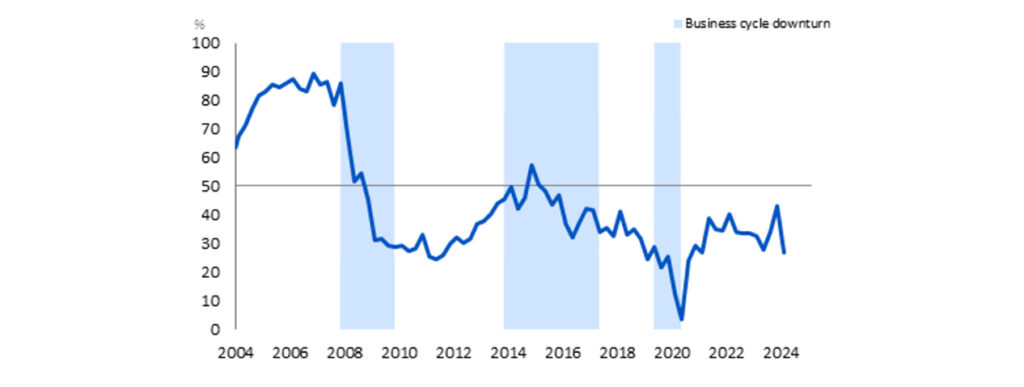
The FNB/BER Building Confidence Index fell from 43 to 27 in 1Q2024. Four of the six sectors surveyed recorded a decline in sentiment of more than 20 points. FNB Senior Economist, Siphamandla Mkhwanazi, expands:
WORDS & GRAPHS: SUPPLIED:: PHOTO UNSPLASH
After rising to an eight-year high in 4Q2023, the FNB/BER Building Confidence Index, which measures sentiment in the building sector, fell by 16 points to reach a level of 27 in 1Q2024. This is the joint lowest level since mid-2020.
The current level of the index means that more than 70% of respondents are dissatisfied with prevailing business conditions.
Alarmingly, most of the sub-sectors included in the index saw a marked fall in confidence. Relative to 4Q2023, the following changes were registered: building material manufacturers (-29), building-subcontractors (-25), architects (-25) and hardware retailers (-23). Main contractors and quantity surveyors recorded an uptick in confidence of 1 and 4 index points, respectively.
Shift in architectural work
By far the biggest turnaround this quarter was registered among architects. Whereas 54% of architects were satisfied with prevailing business conditions in 4Q2023, only 29% stated as such in 1Q2024, in line with a sharp deterioration in current as well as near-term outlook for activity. “The change in sentiment this quarter brings the level back to what it was in 3Q2023. It is easy then to claim that last quarter’s reading was an outlier. However, the trend in terms of activity was similarly volatile. This suggests that there may indeed have been a sudden, and unexpected, shift in architect work this quarter,” notes Mkhwanazi. In contrast, quantity surveyor confidence increased (to 42, from 38 in 4Q2023).”
Main contractors keep pace
Main contractor confidence increased marginally to 42, from 41 in 4Q2023. The largely stable sentiment reflects the trend with respect to overall activity. Looking closer, however, an improvement in residential building activity was partially offset by a somewhat weaker non-residential building performance. Other indicators, such as overall profitability and tendering competition, were broadly similar to 4Q2023, which also explains why confidence was little moved. The indices measuring the constraints to business operations worsened, specifically that of insufficient demand (a proxy for order books) and the shortage of skilled labour which rose to an almost 6-year high.
“The survey among main contractors suggests that activity maintained its (weak) pace in 1Q2024. However, the deterioration in order books and the dire situation at the start of the building value chain suggest that activity may deteriorate over the short term,” he says.
Also contributing to the lower overall sentiment are building material manufacturers (with confidence at 0) and hardware retailers (at 15). According to Mkhwanazi, “some of the listed hardware retailers have released poor company results recently and the confidence reading, and survey activity data align with that. It’s safe to say that the pressure on consumers’ income has had adverse effects on the demand for hardware”.
Growth in activity among building sub-contractors deteriorated, likely signalling a slowdown in demand for particularly electrical contractors that benefitted from residential and non-residential demand for energy installations. This, however, does not fully explain the significant fall in sentiment to 33, from 58 in 4Q2023.
In a nutshell
The FNB/BER Building Confidence Index dropped to 27 in 1Q2024, from 43 in 4Q2023.
While the fall in sentiment was broad-based (and where declines were registered, they were noticeable), it is encouraging that main contractor confidence was higher, supported by somewhat better activity.
Looking ahead, however, the building sector will likely continue to underperform given that activity at the start of the building pipeline (i.e. architect and quantity surveyor activity) fared dismally. That growth could be weaker going forward is also supported by the increase in new building demand as a business constraint.
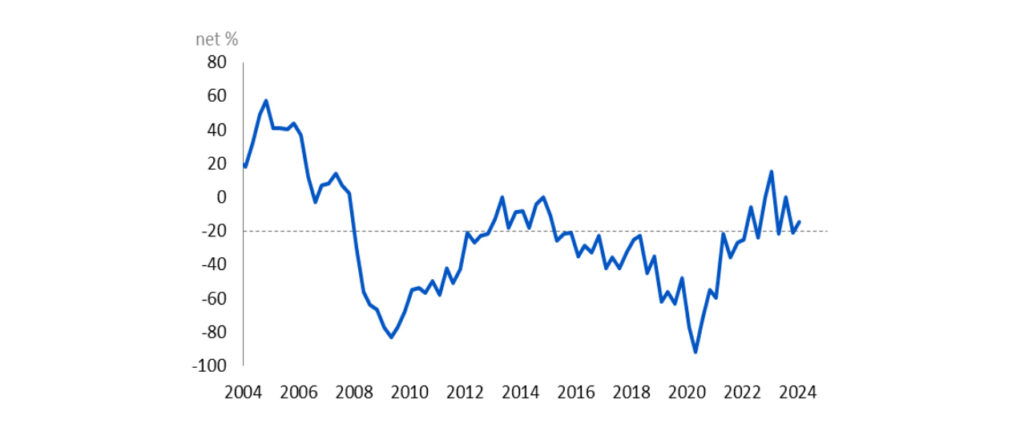
“There was a surge of building activity since 3Q2022 on the back of increased private investment in energy and the lagged effect of the relatively low interest rate environment in 2021 and 2022. Growth has since cooled. Indeed, according to Statistics South Africa, the real value of investment in buildings contracted by an annual rate of close to 6% in 4Q2023. These results suggest that a similarly weak performance is on the cards for 1Q2024,” remarks Mkhwanazi.
To listen to his voice note, click here.
The fieldwork for the fourth quarter survey was conducted between 8 and 26 February 2024. For more information, download revised historical BCI data see here.