WORDS: DEBBIE HATHWAY :: PHOTOS: SUPPLIED
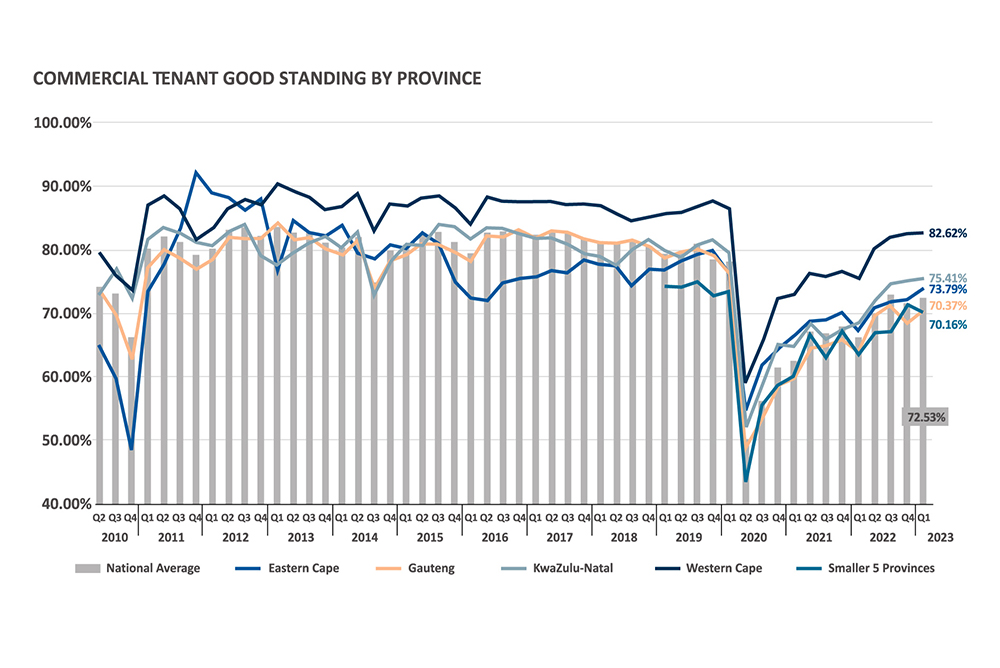
Western Cape commercial property tenants in good standing exceed the national average by more than 10%.
Load-shedding, regulatory uncertainty, and the government’s lack of delivery of basic services contributed to a decline in business confidence in the first quarter of 2023. Compounded by interest rate hikes and the increasing cost of living influencing consumer spending, it’s no wonder businesses are feeling the pinch. Commercial property tenants, those who occupy office, retail, industrial, and storage space, are battling to pay rent, according to TPN’s Commercial Rental Monitor, which tracks performance in this sector across SA.
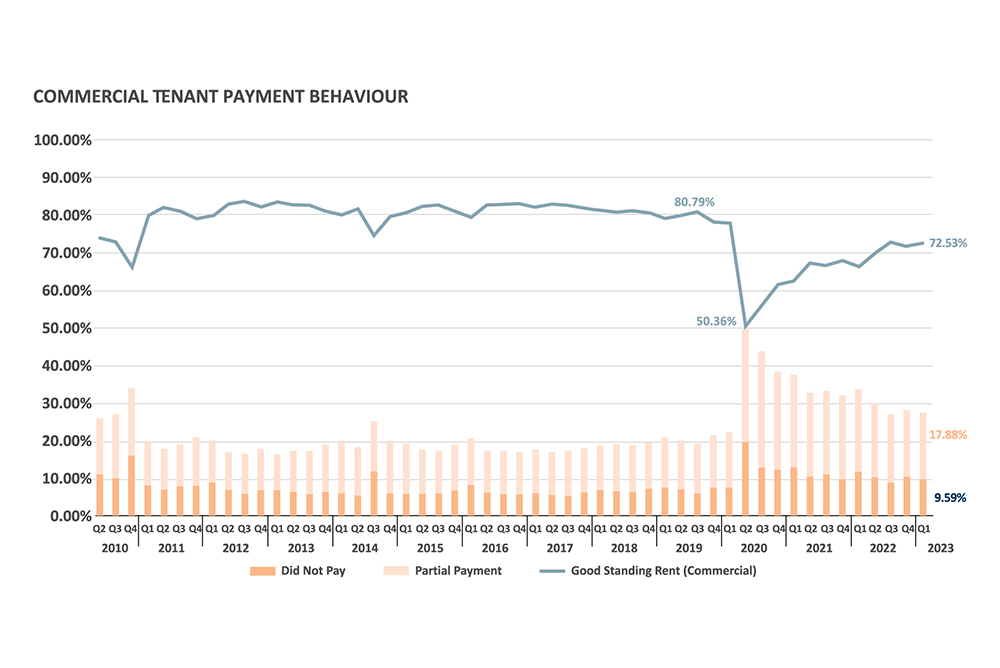
The good news is that the number of commercial property tenants in good standing in the first quarter of the year recovered to 72.53%. Although this is a significant improvement from the pandemic-induced dip of 50.36% in the second quarter of 2020, it is still short of the pre-Covid-19 level of 80.79% recorded in the third quarter of 2019.
Since 2020, the ratio of commercial property tenants that “did not pay” versus those that “paid on time” has remained higher than pre-pandemic levels. In the period under review, 9.59% of tenants made no rental payments compared to 10.27% in 2022 and 10.95% in 2021. The average “did not pay” profile for 2019 was 6.98%, and 6.82% in 2018.
WESTERN CAPE TENANTS LEAD IN GOOD STANDING
Escalating municipal costs are one of the biggest challenges facing commercial landlords. These comprise 61% of total operating expenses and 26.2% of the gross income generated by commercial property, according to the MSCI South Africa IMI Index. In most instances, these costs are passed on to tenants and are reflected an increased consumer prices. As these costs continue to rise, landlords are forced to consider the total cost of occupation while balancing vacancies and ensuring investors’ returns. This places pressure on the base rentals that commercial landlords can request and lowers rental escalations.
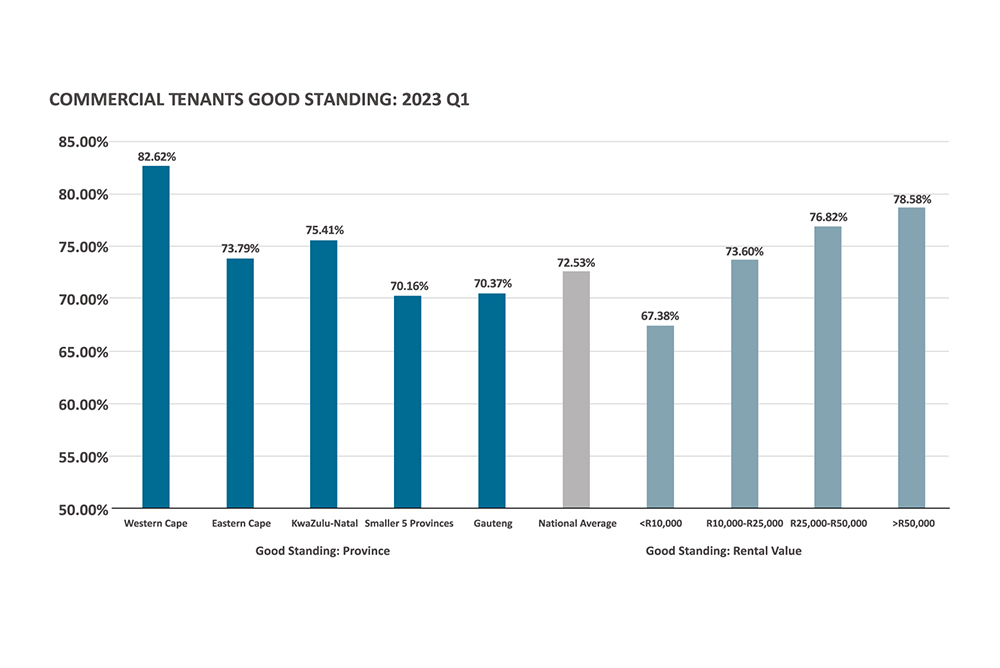
According to Waldo Marcus, industry principal at TPN Credit Bureau, commercial tenants in good standing in the Western Cape total 82,62%, while the national average is 72,53%. Meanwhile, in Gauteng, the economic hub of South Africa, 70% of tenants are in good standing. KwaZulu-Natal has 75,41% tenants in good standing. “Municipal rates and taxes vary countrywide. For instance in KwaZulu-Natal, rates and taxes on industrial property amount to R12,39/m² compared to R3,87/m² in the Western Cape. Regarding retail space, in Gauteng on average, you pay R36,87/m² compared to R23,64/m² in the Western Cape,” he says. Retail tenants have had the steepest climb to recovery, with 73.4% of retail tenants in good standing. The vacancy rate was a low 5.4%.
Despite employees’ gradual return to work in physical office space helping this sector’s recovery, vacancies remain high at 15.8%. The industrial sector is the star performer, with 75.67% of tenants in good standing in the first quarter of 2023. The vacancy rate in this sector is the lowest of all the commercial asset classes.
SMALLER BUSINESSES BEHIND ON RENT
Interestingly, TPN data indicates that the larger the rental, the higher the probability of commercial tenants meeting their rental obligations. This has also helped the office market attract employees working from home without backup power back to their desks. Just under half (42%) of the commercial tenants paying less than R10,000 per month rental have the lowest good standing ratio (67.38%), but those paying R25,000-R50,000+ per month have the best good standing ratio. This means that established and larger occupiers still offer commercial landlords a more assured and secure rental income, paid on time.
“Larger commercial developments can overcome challenges like load-shedding with alternative power supplies, be they generators which most of them have or solar panels,” says Marcus. “Smaller businesses, on the other hand – the small retail, office or factory outlet – don’t have the capital or funds to have uninterrupted power supply and are really struggling. And we’re beginning to see it’s impacting their ability to pay rent to their landlords.”
However, despite the increasingly hostile environment characterised by regulatory uncertainty, currency volatility, and higher utility costs, total returns by SA REITS remain above the JSE All Share Index due to their innovation, agility and fierce commitment to the country and its economic success.
- MRI Software, an established global leader in residential and commercial real estate software, recently acquired TPN. The only credit bureau globally to specialise in tenant behaviour, TPN created the world’s first rental payment profile. Its database has grown to become the most comprehensive and up-to-date authority on tenant behaviour in SA, covering both the residential and commercial sectors and transforming how tenants pay their rent. TPN’s unique data is widely used by organisations such as the South African Reserve Bank (SARB), commercial banks and industry bodies.