South Africans are among the largest groups of foreign buyers in Mauritius, and almost all of them shop with the same figure in mind: a national or regional average read online. The problem is that Mauritius publishes no record of actual sales, the way Lightstone or the Deeds Office do in South Africa. Every average in circulation is built on asking prices, and most of them lump together luxury estates and ordinary family homes.
WORDS & PHOTOS: SUPPLIED
New data published in 2026 by the Mauritian portal Noukaz replaces averages with medians, for every district and every locality, with the number of listings behind each figure.
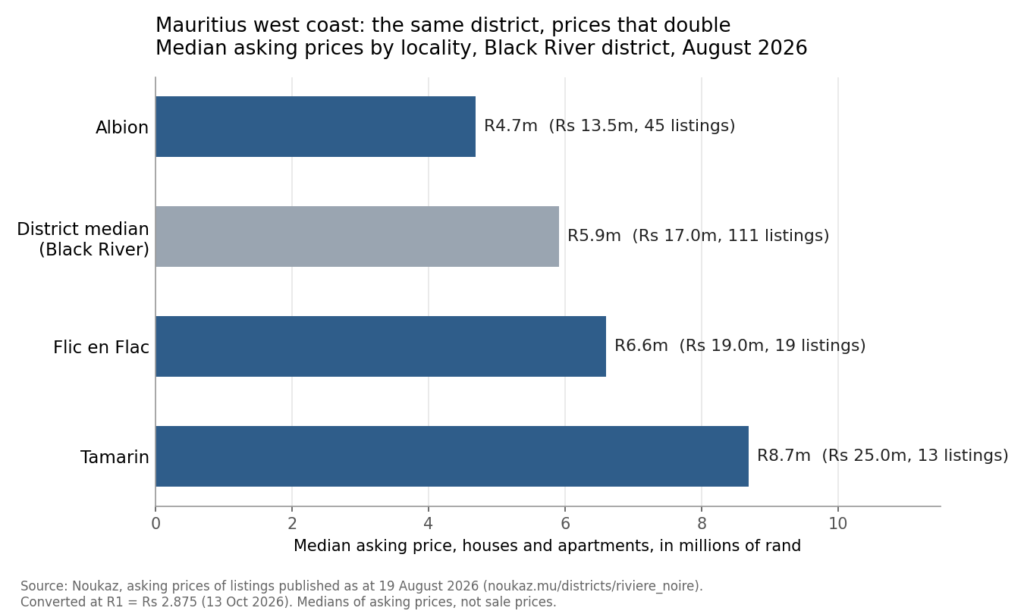
The result on the west coast, where most foreign buyers look, is stark. The Black River district as a whole shows a median asking price of Rs 17 million (about R5.9 million) for houses and apartments. Inside the district, Albion sits at Rs 13.5 million (R4.7 million), Flic en Flac at Rs 19 million (R6.6 million) and Tamarin at Rs 25 million (R8.7 million), on comparable floor areas. The spread between two coastal villages a short drive apart is close to double.
Statistics Mauritius Housing and Population Census
“A South African who budgets on ‘about six million rand for a house on the west coast’ is not wrong, he is just not looking at any real house,” says Keviambal Vidal-Langlois, who runs the portal.
“In Albion that budget buys a four-bedroom house with a pool. In Tamarin it buys a plot. The locality decides, not the coast, and without a sales register the only honest figure is the median of what is actually on the market, listing count included.”
Two other figures explain the market a South African walks into. According to the 2022 Housing and Population Census from Statistics Mauritius, 90.4% of Mauritian households own their home and only 6.5% rent, which is why rental supply is so thin: on the west coast the median asking rent is Rs 45,000 a month (about R15,600) on barely a dozen listings.
And according to the Economic Development Board, which administers the schemes, a foreign buyer still needs to spend at least USD 375,000 in an approved development to qualify for a residence permit; that threshold is almost exactly the district’s median price.
Two rule changes in 2026 matter for anyone comparing the island with South Africa.
The doubling of registration duty for non-citizens, from 5% to 10%, voted in the 2025 Finance Act, was cancelled by the June 2026 budget before taking effect: a foreign buyer in an approved scheme pays 5%, the same as a Mauritian. And new apartments built on state coastal land, the Pas Géométriques, are no longer open to non-citizens, with a 10% levy on resales.