At a recent conference, Professor Adrian Saville took a long hard look at the economic challenges facing South African businesses – and proposed some insights and bold solutions for overcoming them.
In the words of legendary baseball coach Yogi Berra, “It’s tough to make predictions, especially about the future.”
Speaking in the Keynote slot at the recent South African Restructuring and Insolvency Practitioners Association (SARIPA) conference, well-known author and economist Professor Adrian Saville painted a realistic but ultimately hopeful picture of South Africa’s economic outlook.
SARIPA is a non-profit organisation, constituted in 1986, with a nationwide membership of close to 800 insolvency practitioners, business restructuring professionals, chartered accountants, lawyers, bankers, academics, and tax consultants and others involved in liquidation, insolvency and business rescue services. It engages in open dialogue to address challenges affecting its members.

Greg Dart – High Street Auction Co Director and Professor Adrian Saville
“We’ve seen 1,180 businesses declare bankruptcy this year through September,” says High St Auction Co. director Greg Dart. “This is an almost 4% increase on last year. And in many if not most of these cases, externalities have been to blame. 2025 has been a particularly rough year for business, as a result of both global instability and local constraints.”
Adrian Saville Insights on South Africa’s Business Challenges
Saville confronted some of these challenges head-on, while suggesting novel solutions to some of the trickier problems faced by South African businesses today. These Adrian Saville insights offered a grounded yet forward-looking perspective on the nation’s economic landscape.
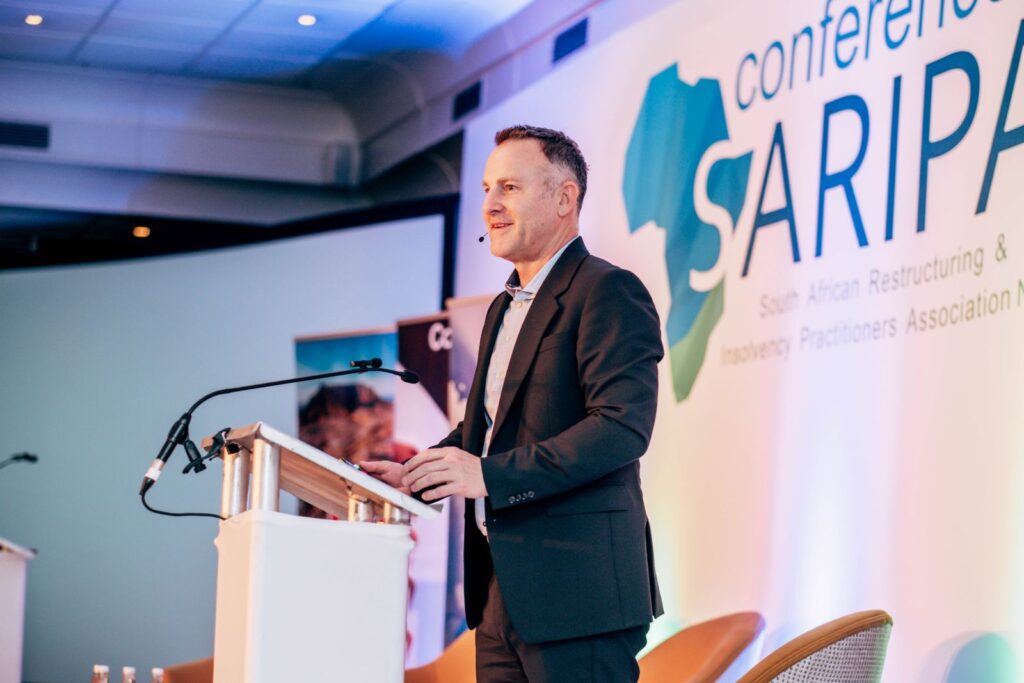
He began with a warning: prediction, especially for economists, is a tricky business, and provided several examples of instances where it would have been impossible to predict the priorities businesses would face – including COVID 19, the inflationary wave which ensued, and the chaotic tariffs regime of the Trump 2.0 era.
He highlighted agility as a critical attribute for businesses in times of uncertainty. “Agility is the ability to choose your speed to invent, to reinvent,” he said. “How do you win by not doing what your competitors, opponents are doing? That’s the essence of competitive strategy.” He gave the example of Muhammad Ali’s victory against George Foreman in Kinshasa, where instead of trying to fight the champion on his own terms, Ali used the ropes to absorb Foreman’s blows in his famous rope-a-dope strategy that eventually wore his opponent out.
Economic Growth and Strategic Planning
Saville is relatively sanguine about South Africa’s economic future, measuring our performance against six markers: savings and investment, demographics, policy and institutions, education, healthcare, and openness. Although we currently lack the ability to achieve the 6–7% GDP growth chalked up by countries like Ethiopia and Rwanda, he says, some of our fundamentals are promising. “We have the industrially most complex economy in the region,” he said.
“That’s good for positioning us to prospective partners. If you’re going to build photovoltaic, renewable energy, there’s no better place than South Africa. We also find ourselves in a world with elevated commodity prices. That is good news for South Africa as a small, open, commodity-based economy.”
These Adrian Saville insights underscore both the country’s strengths and its structural constraints.
Challenges, Opportunities, and the Need for Agility
Among our challenges, he noted, are a relatively low rate of saving. “Every country that has transitioned to prosperity, has an elevated savings and investment rate of 25% of GDP and higher,” he said. “South Africa’s number has been stuck at 15% for 15 years. This puts us firmly entrenched in 1–1.5% growth territory.”
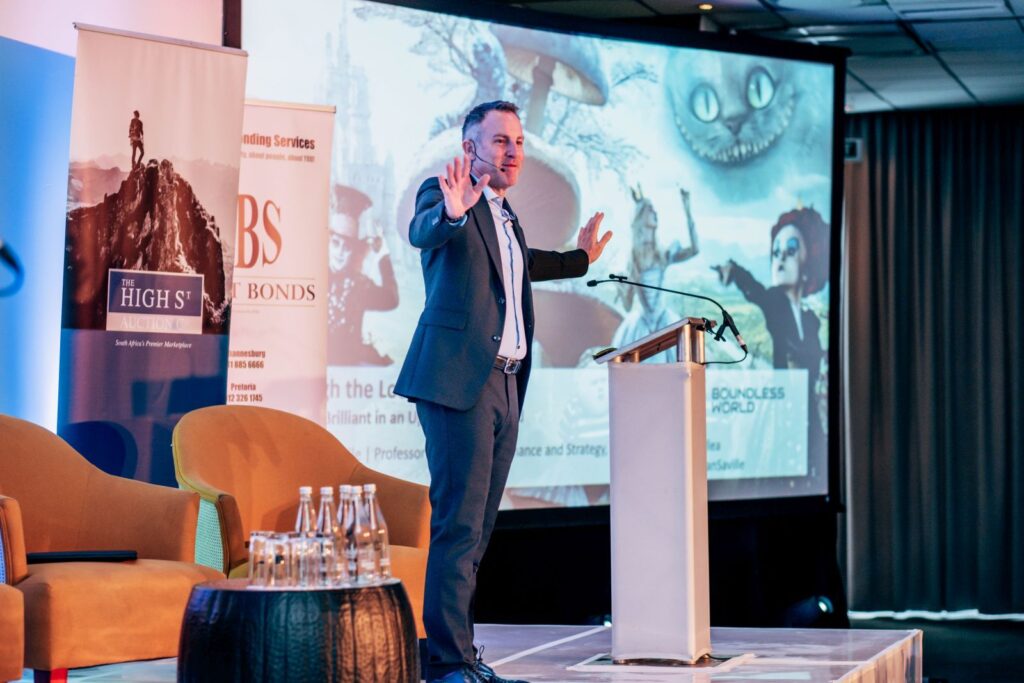
He also pointed to external economic factors in the success of businesses, showing that 53% of a company’s revenue growth and 47% of its earnings growth is explained by GDP growth. South Africa’s economy has been growing at less than 1% for the last 15 years, outpaced by population growth. This, he said, was both our single biggest challenge and our single biggest opportunity. These Adrian Saville insights highlight the deep connection between national growth and corporate performance.
He concluded by emphasising the importance of shorter-term planning in the face of uncertainty, drawing a contrast between Malawi’s vision for 2063, and Elle Johnson Sirleaf’s more realistic 150-day plan when she took over the presidency of Liberia in 2006.
“You can’t hide from much in 150 days,” observed Saville. “That’s our call to action.” These closing Adrian Saville insights serve as a pragmatic reminder of the value of agility, focus, and measurable goals in an unpredictable environment.
SARIPA Chair, Jo Mitchell-Marais, said that Professor Saville – whose participation was made possible by High St Auction Co, set the tone for the conference in his address, challenging turnaround and restructuring professionals to rethink strategy. “It’s modelling for the unknown,” she said. “That’s how you build resilience”