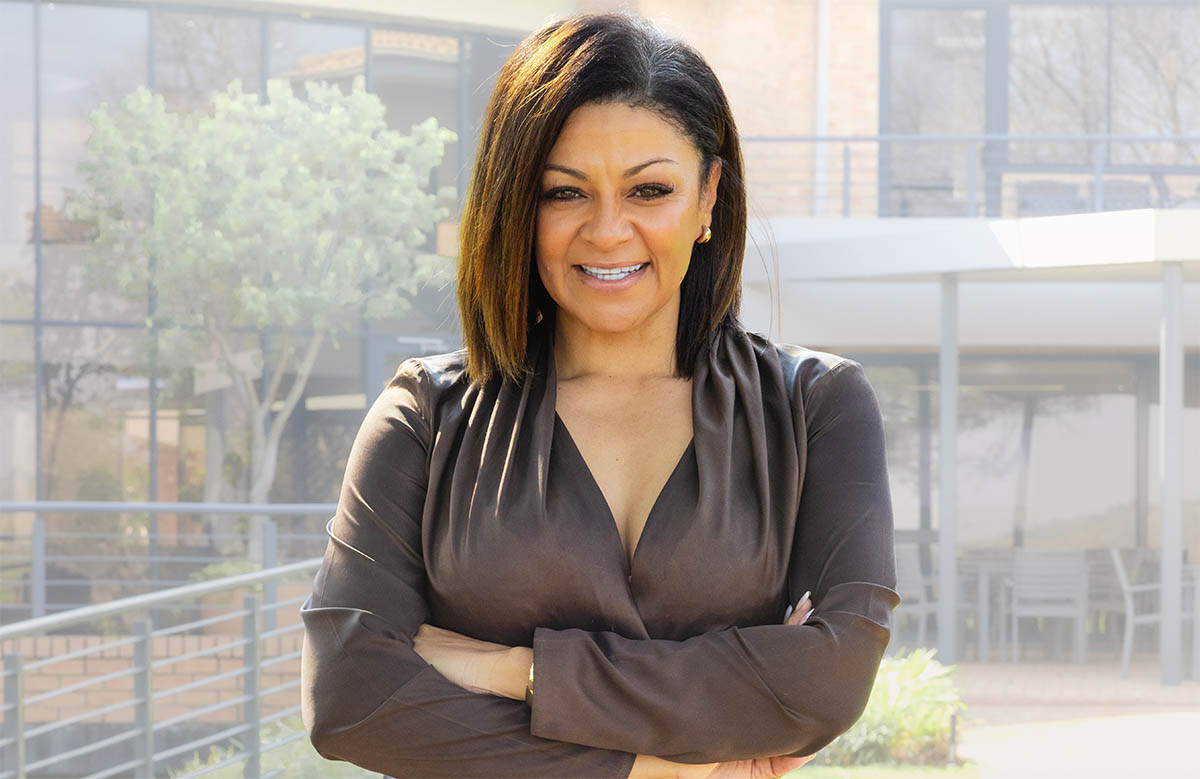
Abcon’s Group Marketing Manager, Caley May started her career marketing a casino floor. Today, she markets office parks, retail precincts and residential communities. On paper, those two worlds have nothing in common. In practice, they taught her the same lesson from opposite directions: when your product touches people’s money, their time or their sense of belonging, trust is the actual product. Caley tells us more.
WORDS & PHOTO: SUPPLIED
“I’ve never planned my career as a straight line and looking back, I don’t think the best careers ever are. Mine has taken me through Sun International’s Boardwalk Casino, into listed property funds like Redefine and Rebosis and now into Abcon, building precincts like Sandton Gate, Loftus Park and Fleurhof Mall. Three sectors. Three very different regulatory environments. Three very different relationships with the public. And yet the core question I’ve had to answer at every stop has been identical: how do you market something responsibly when the person on the other side of the message is more exposed than you are?”
She adds: “In gaming, that question is loud and unavoidable. Regulators watch you. Responsible-gambling messaging isn’t optional and every campaign lives under the assumption that someone, somewhere, could be marketing to a vulnerability rather than a want. You learn very quickly that the line between “compelling” and “irresponsible” is a daily judgement call and you make it in rooms where the commercial pressure never fully goes away.”
The listed property domain
She says that, moving into listed property the pressure changes shape, but doesn’t disappear. “You’re no longer marketing to individual consumers chasing a night out; you’re communicating to institutional investors, analysts, tenants and, ultimately, the market itself. Get a public statement wrong, oversell a development timeline and the exposure isn’t reputational alone, but also financial and public. Listed property taught me precision. It taught me that in a regulated, disclosed environment, the truth has to survive scrutiny long after the press release has been forgotten.”
“And now, at Abcon, the question has become the most human version of all three. When we open Fleurhof Mall between Soweto and Roodepoort, or bring Sandton Gate Central to life on the Braamfontein Spruit, we’re telling thousands of people that a place will be part of their daily life, their commute, their livelihood, their neighbourhood. That’s a different kind of trust altogether. It has to be earned before a single tenant moves in and it has to be honoured for decades after, because a precinct doesn’t disappear when the campaign ends. People live inside your marketing for the next twenty years.”
“What I’ve come to believe, moving between these three worlds, is that responsible marketing is a discipline of asking who is more vulnerable in this exchange, and building the message around protecting that person, not extracting from them. In community-facing development, it’s the resident, the small tenant, the commuter who now has to route their day around what you’ve built.”
“I share this, in Women’s Month particularly, because I think women in marketing are often quietly better at holding this discipline than we’re given credit for. We’re frequently the ones in the room asking “but is this actually true and is it actually fair,” while the commercial pressure is pushing for louder and faster. I’ve learned not to apologise for that instinct. It isn’t caution for its own sake. It’s the thing that makes a brand successful past the campaign and a career survivable past the next role.”
Marketing careers in property
“Her advice to women building marketing careers across industries, especially in property, is this: “Don’t be afraid of the sector-hop. Every regulated, trust-sensitive environment you work in sharpens the same muscle from a new angle. You don’t need a straight-line CV to build deep expertise. You need to keep asking the same hard question wherever you land: who is on the other side of this message and would I be comfortable if they knew exactly how it was built? If the answer is yes, you’re building something people can actually trust enough to live inside.”