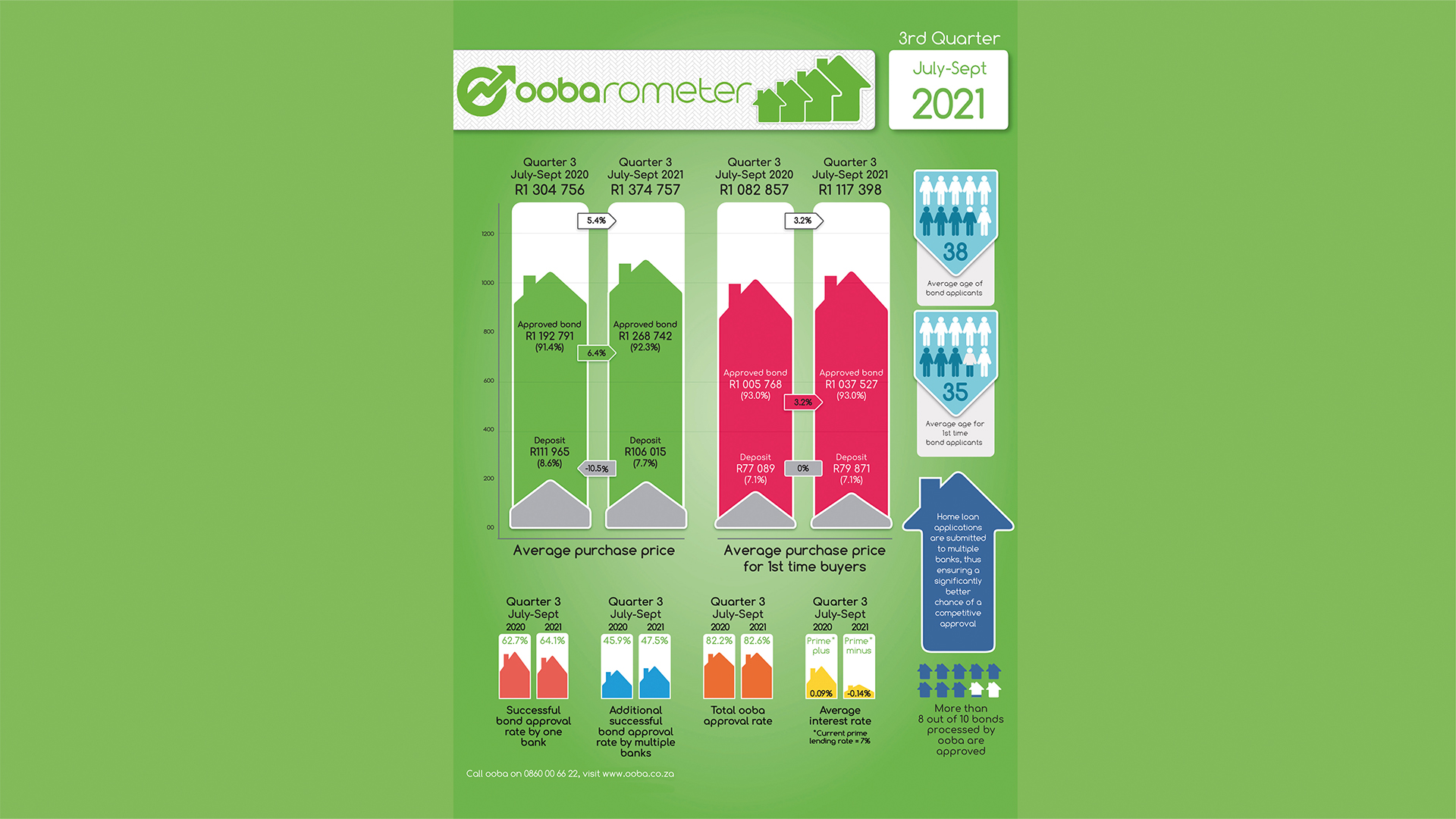
Despite the ongoing upheaval caused by the Covid-19 pandemic, coupled with civil unrest in KwaZulu-Natal and Gauteng earlier this year, statistics for the third quarter of 2021 (Q3 21) from ooba, a leading home loan comparison service, show that lending conditions remain advantageous to home loan applicants. The pandemic has drastically changed consumer behaviour as well as banking trends, resulting in a surprising boom in the local residential property market over the past 12 months, says Rhys Dyer, CEO of ooba.
THE GOOD NEWS
He says home buying and mortgage lending have remained relatively immune to the pandemic. “Despite slower growth in property prices for this quarter, we expect residential property prices to continue increasing.” The ooba statistics show a retreat from previous double-digit to single-digit property price growth with the average purchase price increasing by 5.4% year on year compared to the third quarter of 2020 (Q3 20). “The local banking industry appears to be optimistic about the future of the South African residential property market,” he says. “The current lending landscape remains competitive, which is evidenced in the softening of their deposit requirements and approvals at interest rates on average below prime.” The usual deposit as a percentage of the purchase price declined by 10,5% year on year.

WHO IS BUYING?
Of all home loan applications received by ooba in Q3 21, 50% were from first-time homebuyers – almost 63% of ooba’s first-time buyer applications in Q3 21 were for zero-deposit bonds compared to 60% in Q3 20. “Zero-deposit bonds are sought after among first-time homebuyers. Our approval rate for 100% bond applications this quarter was 81.5%, up by 1.4% on the third quarter of 2020,” he says.
FEMALE BUYERS
With the lower cost of borrowing boosting affordability, ooba’s statistics show growth in homebuyers buying alone as opposed to co-buying. This segment of homebuyers has grown to close to 60% of ooba’s applications since the beginning of the pandemic. Female homebuyers currently dominate this single-owner segment, constituting more than 51% of applications. Since April last year, applications from women buying on their own increased by 4%. “Purchasers buying properties as buy-to-let investments increased to 7% of applications in the third quarter, compared to 5% in the third quarter of 2020. Current lending and buying conditions are perfect for property investors,” Dyer says.