South Africa’s housing market records the strongest house price growth since 2021. All comments below by Dr Andrew Golding, chief executive of the Pam Golding Property group:
The Monetary Policy Committee’s (MPC) decision today (23 July, 2026) to leave the repo rate unchanged provides welcome relief for consumers with debt, including mortgage holders, and for prospective home buyers. While households continue to contend with elevated fuel prices and rising electricity and municipal tariffs, the decision offers greater certainty for consumers and businesses at a time of heightened global economic uncertainty.
Inflation risks remain, but policymakers opt for caution
MPC members faced a particularly difficult decision following the release of the June Consumer Price Index (CPI), which rose to a higher than anticipated 5%, up from 4.5% in May. Of particular concern is that, with oil prices rising above US$90 a barrel and the rand under pressure, the inflation outlook has become more challenging, particularly as tensions in the Middle East continue to escalate.
Prior to the release of the June CPI data, analysts had largely anticipated that the MPC would pause the hiking cycle. Although core inflation increased to 4.1% in June, edging above the South African Reserve Bank’s (SARB) 3% target and beyond its 2-4% tolerance range, policymakers ultimately elected to keep rates unchanged while continuing to monitor inflation risks and developments in the global environment.
The increase in core inflation, which excludes fuel, electricity and food prices, suggests that underlying inflationary pressures are becoming more persistent and are broadening beyond these volatile components. Together with the deteriorating inflation outlook, this raises concerns about the potential emergence of second-round effects, where higher input costs begin to feed through more broadly into prices across the economy.
Supporting growth while remaining vigilant
Consumers continue to face a challenging environment. However, the MPC’s decision recognises the importance of balancing inflation risks with the need to support economic activity and household finances.
Maintaining the current interest rate provides breathing room for homeowners and prospective buyers, while helping to sustain confidence in the residential property market. At the same time, the SARB’s accompanying guidance makes it clear that policymakers remain vigilant and stand ready to act should inflationary pressures become more entrenched.
It is hoped that the recent rise in inflation will prove to be a temporary setback driven largely by higher fuel costs and currency weakness, rather than the beginning of a more persistent inflationary cycle requiring additional monetary tightening.
Strongest house price growth since 2021
Despite ongoing global and domestic headwinds, South Africa’s residential property market continues to demonstrate resilience and healthy capital appreciation, with national house price inflation (HPI) accelerating to 5.1% in June and averaging 4.8% during the first half of 2026. This represents the strongest national house price growth since the post-pandemic rebound in 2021, when HPI averaged 5.5%.
According to the Pam Golding Residential Property Index, the Western Cape continues to outperform by an increasing margin, averaging 10.3% during the first half of 2026, well ahead of Gauteng (3.0%) and KwaZulu-Natal (2.8%).
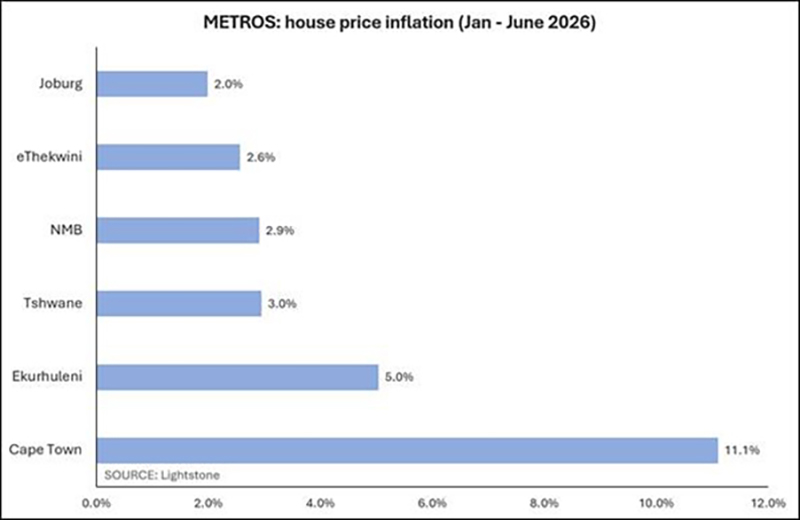
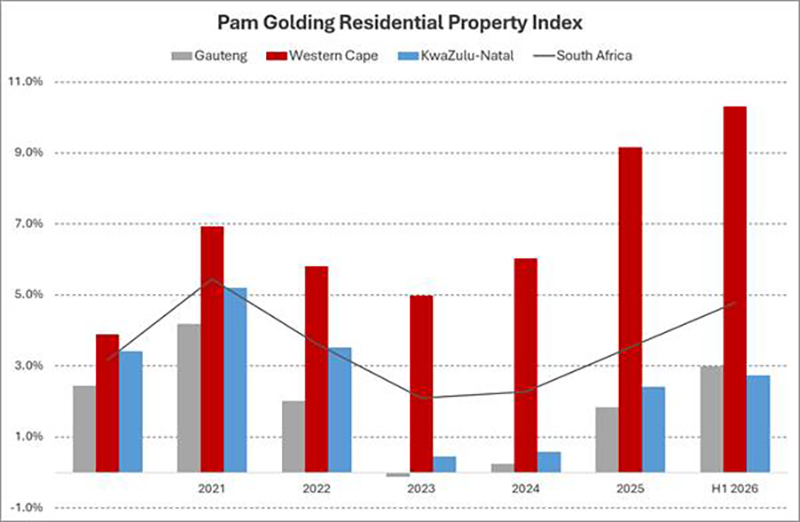
Graph sources above: Lightstone, and Pam Golding Residential Property Index.
Interestingly, coastal house price inflation has stabilised at approximately 5% during H1 2026, while growth in non-coastal house prices has continued to accelerate, reaching 5.4% in June and outperforming coastal HPI for the fourth consecutive month.
The gap between freehold and sectional title house price inflation also continues to narrow, with freehold price growth increasing to 6.3% in June, while sectional title HPI accelerated to 4.9%.
Among the major metropolitan markets, Cape Town once again led the country in H1 2026, with average house price inflation of 11.1%, followed by Ekurhuleni at 5.0%.
Buyer demand and lending conditions remain supportive
Encouragingly, first-time buyer applications rebounded to 48.8% in June 2026 and averaging 48% during the first half of 2026, according to ooba Home Loans, up 1.6 percentage points from a year earlier. Growth in first-time buyer demand during H1 2026 was concentrated in more affordable regions, with the Free State (+8.1 percentage points) and Gauteng South and East (+3.3 percentage points) recording the strongest gains compared with the same period last year.
According to ooba, average concessions relative to prime improved in seven of the nine regions during H1 2026 compared with year-earlier levels, while the national approval rate averaged 83.9%, up 0.83 percentage points year on year. Applications for 100% home loans averaged 56.9% during the first half of the year, an increase of 1.9 percentage points from year-earlier levels, reflecting banks’ willingness to lower barriers for cash-constrained households.
Approval rates for pre-qualified applicants remained particularly strong at 91.2%, while approval rates for non-pre-qualified buyers averaged 80.3%.