Commercial
Rosebank in Gauteng has emerged as a property hotspot – Is it a sure investment right now?

The question of where to invest in South African property is becoming less about geography and more about value. While the Western Cape remains a blue-chip market enjoying sustained demand, investor attention is widening to include Gauteng – particularly areas offering a compelling combination of accessibility, amenities and yield. Rosebank is emerging as one of the most notable of these, shaped by strong fundamentals and a maturing urban ecosystem that continues to attract both corporate and residential demand.
WORDS & PHOTOS: SUPPLIED
According to a recent report by Rainmaker, Gauteng remains South Africa’s economic centre, contributing around 33% of national GDP and 30% of employment, while also recording the highest net migration gains nationally. This concentration of economic activity continues to support demand for residential property in well-located urban locations.
The area has seen sustained development across residential, commercial and mixed-use projects, positioning Rosebank as one of Johannesburg’s most established high-density urban centres.
Flyt Property Investment, historically focused on the Western Cape market, is among those expanding their footprint. The group has identified Rosebank as a strategic investment hotspot, partnering with LivRES, the developers of Saxon Square, to launch its latest aparthotel offering through its hospitality brand, WINK Aparthotels. Located on Oxford Road in Rosebank, Saxon Square is a mixed-use development comprising over 150 residential units, positioned within one of Johannesburg’s most active commercial and lifestyle precincts.
“Cape Town continues to deliver strong performance and remains an important part of our investment strategy,” says Ryan Flowers, Managing Director of Flyt Property Investment. “At the same time, we’ve been assessing opportunities in Gauteng, and Rosebank stands out for its accessibility, infrastructure and its potential to deliver consistent rental demand.”

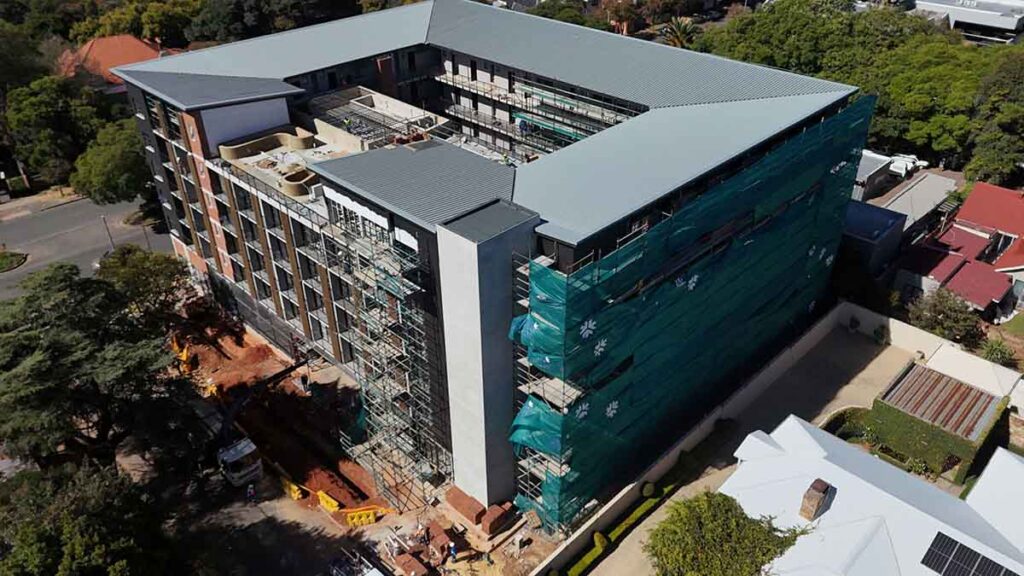
Saxon Square is a mixed-use development comprising over 150 residential units, positioned within one of Johannesburg’s most active commercial and lifestyle precincts.
Broader market dynamics
The divergence between regions is also shaped by broader market dynamics. The Western Cape has benefited from consistent municipal performance, infrastructure reliability and a strong tourism-driven economy, all of which have supported sustained property demand. By contrast, parts of Gauteng have experienced more uneven growth, with investor sentiment at times influenced by concerns around municipal delivery and infrastructure reliability.
Well-performing areas such as Rosebank, already known for its established schools, walkable streets and vibrant retail appeal, are beginning to stand out within this context, supported by concentrated investment and strong corporate demand.
That shift is visible in the corporate footprint of the area. In recent years, a number of major companies have either relocated to or consolidated offices within Rosebank, including Anglo American, which moved its global headquarters to the centre, as well as Standard Bank, Allan Gray and TotalEnergies. The continued growth of precincts such as Oxford Parks has further attracted blue-chip tenants, reinforcing Rosebank’s role as a key commercial hub.
What’s increasingly bolstering the investment case is the strength of the rental market. Vacancy rates in Rosebank have declined from over 15% in 2021 to around 8% by late 2025, pointing to improving occupancy and consistent demand for well-located units.
This is translating into a more compelling buy-to-rent proposition, with recent industry insights pointing to gross rental yields of between 11% and 13%, supported by strong occupancy and corporate-driven demand.


Ryan Flowers, MD of Flyt Property Investment
In nodes like Rosebank, demand for short-term and aparthotel-style accommodation is also becoming a more visible part of the market mix.
Recent data reflects this broader momentum. Rosebank recorded a 53% increase in transaction volumes since 2023, placing it among Johannesburg’s strongest-performing suburbs over the past two years. The area has also attracted a notable share of international buyers, with foreign purchasers accounting for 19% of transactions between early 2024 and 2025.
“Investors are increasingly focused on areas where people can live, work and access amenities within a single urban district,” adds Flowers. “Rosebank aligns with that shift, particularly for buyers looking at long-term rental income.”
The Rainmaker report further points to strong underlying fundamentals supporting the node. Household incomes in Rosebank have increased by approximately 171% since 2011, reinforcing ongoing demand.
From a development perspective, investment into Rosebank remains consistent.
“There has been sustained capital investment into Rosebank across both commercial and residential sectors,” says Alan Dinne development director at LivRES. “The presence of large corporates, combined with continued infrastructure upgrades, is reinforcing its role as a key urban centre within Johannesburg. It’s not just about lifestyle anymore – it’s about opportunity, affordability and long-term stability.”
All indicators suggest that Rosebank is transitioning into a more mature, high-density mixed-use urban pocket, with growth expected to continue as development activity stabilises and demand remains steady.
For property investors looking for value in Johannesburg, Rosebank is emerging as one of the most attractive opportunities in the current market cycle.